Bruce Lowe’s alarm goes off at 4:30 a.m. It’s mid-December, and he’s got exactly three weeks to capture a year’s worth of work.
He pulls on his bee suit, loads his truck with empty honey frames, and heads into the Coromandel bush. The Manuka trees are in full bloom, covered in white flowers that look like tiny explosions of cotton. In a few weeks, they’ll be gone.
“People think beekeeping is a year-round job,” Lowe says, smoke billowing from his hive tool as he checks the frames. “With Manuka, you’ve got one shot. Miss it, and you’ve got nothing.”
This is where your $80 jar of honey begins: in a narrow window of summer, in some of New Zealand’s most remote corners, with beekeepers racing against the clock.
The Flowering Frenzy
Manuka flowers bloom for just two to six weeks, depending on weather and location. In the North Island, this usually happens between November and January. In cooler South Island spots, it might stretch into February.
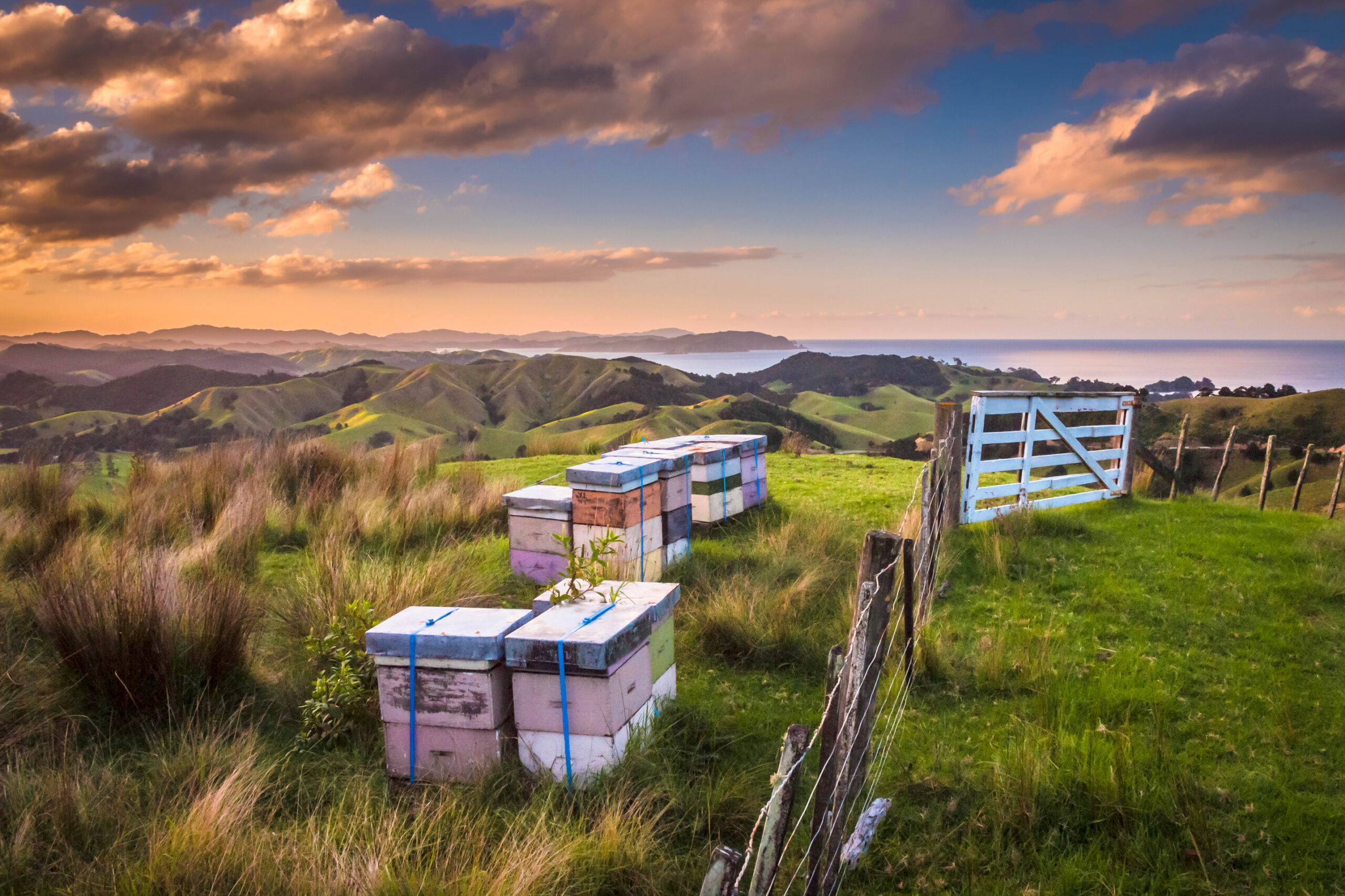
During this window, beekeepers move fast. Lowe manages 1,800 hives scattered across the Coromandel Peninsula. Some sit beside dirt roads. Others require a helicopter to reach.
“I’ve got hives on ridge tops that take an hour to hike to,” he says. “But that’s where the best Manuka grows, away from other flowers.”
Location matters because bees don’t discriminate. Put a hive near a Manuka forest that’s also close to farmland, and your bees will happily visit clover, dandelions, and whatever else is blooming. The honey might taste fine, but it won’t have the high MGO levels that make Manuka special.
Pure Manuka honey comes from hives surrounded by dense Manuka bush, far from competing flowers. That means rugged terrain, long drives, and sometimes angry bees worked up by the summer heat.
Inside the Hive
A healthy Manuka hive is chaos in the best possible way. Thousands of bees crawl over frames thick with honeycomb, their bodies dusted with pollen.
Lowe pulls out a frame and holds it up to the light. The comb is nearly full, the cells capped with wax. “This is ready,” he says.
Each bee in that hive has a job. Young bees stay inside, feeding larvae and processing nectar. Older bees venture out to forage, visiting thousands of flowers each day. A single bee might make 12 foraging trips before she dies, usually after about six weeks of life.
The nectar they collect is roughly 80 percent water. Back at the hive, house bees pass it from mouth to mouth, adding enzymes that break down complex sugars. They fan their wings to evaporate the water. After a few days, what started as watery nectar becomes honey with less than 20 percent moisture.
Then they seal it with wax and move on to the next cell.
The Great Extraction
Late January, and Lowe’s packing shed hums with activity. He and two workers are processing the summer’s harvest.
The frames come off the truck still warm from the hives. First, they slice off the wax cappings with heated knives. Then the frames go into an extractor, a big steel drum that spins like a washing machine. Centrifugal force flings the honey out of the comb and against the walls, where it drips down into a collection tank.
No heat. No pressure. Just spin and gravity.
“Heat destroys the MGO,” Lowe explains, stirring the thick amber honey pooling in the tank. “We keep everything below 35 degrees Celsius. Anything hotter and you’re basically making expensive sugar syrup.”
The honey flows through a series of filters that remove bits of wax and bee parts but leave the pollen intact. Pollen is crucial. It’s one way to prove the honey actually comes from Manuka plants.
From the filters, the honey goes into food-grade drums, each holding 290 kilograms. Lowe sticks a label on each drum with the date, location, and hive numbers. This traceability starts here, in his shed, and follows the honey all the way to store shelves.
The Testing Gauntlet
Before Lowe’s honey reaches anyone’s toast, it faces a series of tests that would make a customs officer jealous.
First stop: the lab. Samples from each drum get tested for MGO levels, DHA content, and leptosperin (a compound unique to Manuka). They check moisture levels, pH, and conductivity. They test for antibiotics and contaminants.
Most importantly, they run DNA analysis on the pollen. Manuka pollen has a distinct genetic signature. If the honey contains less than 70 percent Manuka pollen, it can’t be sold as monofloral Manuka honey.
“We had one batch last year that tested at 68 percent,” Lowe says. “Perfectly good honey, but I had to sell it as multifloral at half the price. That’s $15,000 gone because the bees visited the wrong flowers.”
The testing takes about two weeks and costs roughly $200 per sample. Lowe tests every drum.
Honey that passes gets a UMF or MGO rating based on its methylglyoxal content. This number determines the price. Honey with MGO 263+ might sell to a packer for $40 per kilogram. Honey with MGO 850+ can fetch $120 per kilogram or more.
The Packing Plant
Lowe sells most of his honey to OEM resellers. This is where bulk drums become retail jars.
The packing plant looks more like a pharmaceutical factory than a food facility. Workers wear hairnets and gloves. The equipment gets sanitized between batches. Every jar gets a batch code that links back to Lowe’s original drums, his hive locations, and the lab test results.
The honey never gets heated above body temperature. It flows through heated pipes just warm enough to keep it liquid, then fills jars on an automated line. Each jar gets a label with the MGO or UMF rating, a license number, and a traceability code.
“Scan that code and you can see exactly which hives the honey came from,” says Michelle Park, who runs the packing operation. “We can trace it back to the GPS coordinates of the hive site if needed.”
This traceability isn’t optional. New Zealand law requires it for all Manuka honey exports. It’s the country’s defense against the flood of fake Manuka flooding global markets.
The Long Road to Your Kitchen
From the packing plant, the honey splits into two streams. Some goes to New Zealand stores and reaches shelves within weeks. The rest gets loaded into shipping containers bound for Asia, Europe, and North America.
A jar leaving Aongatete in February might sit in a warehouse in Singapore, then move to a distributor in London, then finally reach a shop shelf in April. By then, Lowe is already preparing for the next season, moving hives and repairing equipment.
The price has roughly tripled since it left his shed. A kilogram of honey he sold for $50 retails for $150 or more. The markup covers testing, packing, shipping, import duties, and retailer margins.
“People see the price and think beekeepers are getting rich,” Lowe says. “But by the time I pay for hives, equipment, testing, and labor, I’m making less than minimum wage most years.”
He keeps doing it anyway. So do about 2,000 other registered Manuka beekeepers across New Zealand.
Why It Matters
That expensive jar in your cupboard represents a chain of work stretching from remote hilltops to high-tech labs. It’s summer heat and bee stings, lab tests and traceability codes, GPS coordinates and genetic analysis.
It’s also your guarantee. Those ratings and batch numbers mean Lowe can’t cut corners. The lab results are public record. The traceability is locked in.
“Every jar tells a story,” Lowe says, closing up a hive as the afternoon sun slants through the Manuka trees. “Our job is to make sure it’s a true one.”